
Sustainability
Reuse instead of single use.
Most pallets that reach us would have ended up as waste elsewhere. We sort them, repair them and return them to circulation. That is our business — and at the same time the opposite of throwing things away.
Measured, not estimated
What has passed through our plant.
- used EPAL pallets sorted
- 208'442
- of which arrived damaged
- 101'634
- pallets repaired
- 106'740
Each one recorded individually and assigned to a quality class — A, B, C or damaged. The class determines the route a pallet takes next.
Almost every second one. Elsewhere that is the moment a pallet becomes waste — with us it goes to repair.
Repaired to EPAL guidelines and back in service — every one a pallet that did not have to be built new. More than was classed as damaged in the same period: we also repair what came in earlier.
Period 2026-05-15 – 2026-09-12 · as at 2026-09-13. Counted in the sorting process, which assigns every pallet individually to a class — the same booking our customers receive their sorting reports from.
How we work
The loop only closes if someone closes it.
Repair where others discard
A damaged pallet is not waste to us, it is material. Our repairers bring it back to standard under the EPAL guidelines — same dimensions, same nails, same load capacity as a new one. Only what cannot be brought back to standard is taken out.
View credentialsReuse instead of single use
In pooling, the pallet never leaves the cycle in the first place. We collect it from the customer, sort it, repair it and deliver it back. The same pallet carries loads for years — instead of running once and then vanishing.
View poolingAnd what is left over
What can no longer be saved does not go to landfill — over the period measured that applied to 6'591 pallets, a good three in a hundred. Their timber goes as waste wood to a licensed waste-wood plant and replaces fossil fuels there.
EPAL licence
We repair to the guideline — not by feel.
A repaired EPAL pallet may only be called EPAL again if the business is licensed for it and follows the rules: which boards may be replaced, which nails, which blocks, how it is checked. We are a licensed EPAL repair operation. That is the difference between a pallet accepted in the European exchange and one that stays standing at the loading bay.
View repair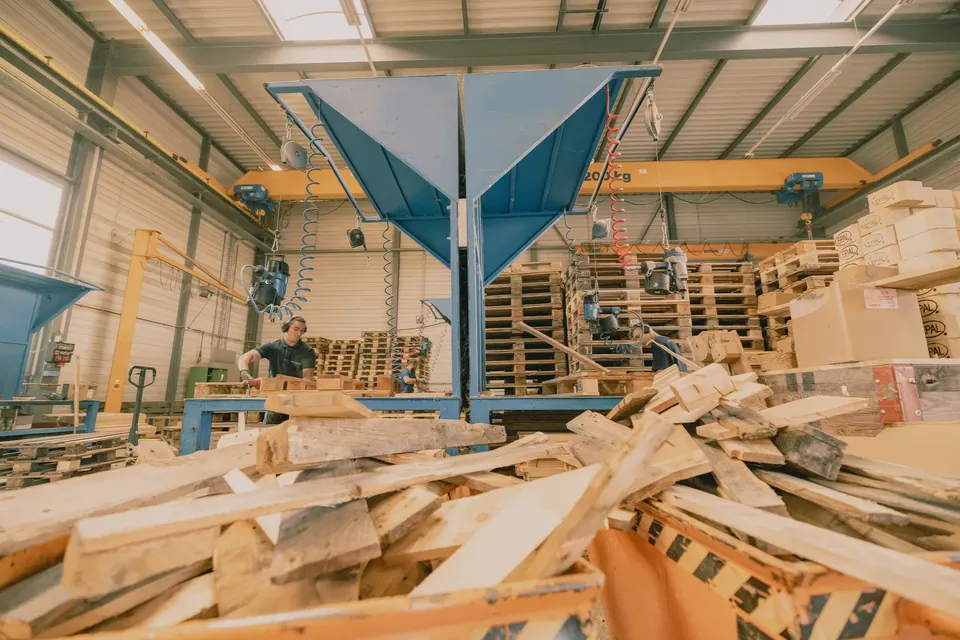
Transport
Three out of four trucks run on electricity.
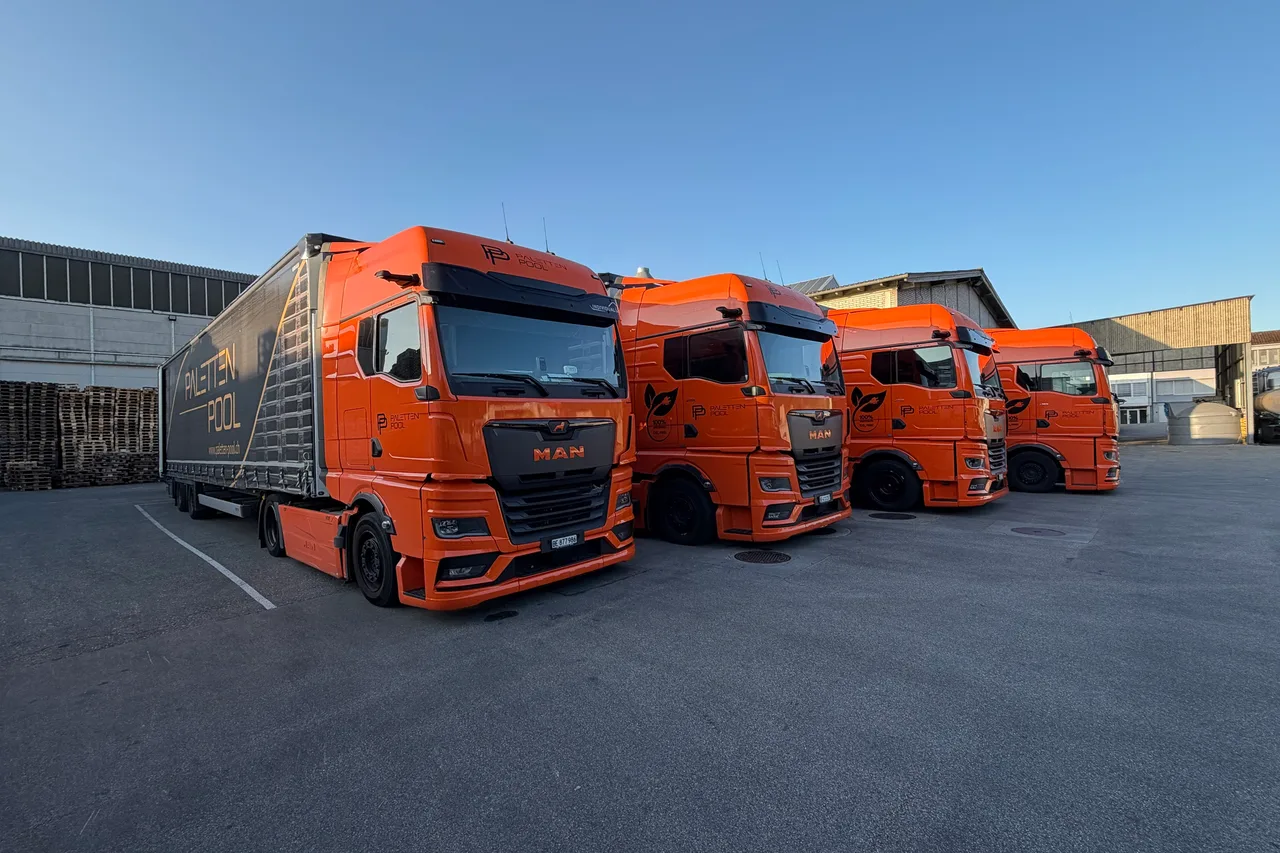
Returning a pallet to circulation means driving it — collection, plant, delivery. Those journeys are where we started: the core of our fleet today is three fully electric MAN eTGX. They run the daily collection and delivery rounds, not one showcase vehicle for the brochure.
For routes that electric range cannot cover today, one diesel truck remains in service — in the photo the one at the front, with the semi-trailer. We write that down instead of leaving it out: a fleet that sounded a hundred per cent green would simply not be true in our business.
3/4
electric trucks MAN eTGX
Verified from outside
Verified, not asserted.
Sustainability is a word that is easy to say. That is why we have it checked — environmental management, the whole supply chain, the origin of the timber and the craft on the pallet itself. Every award is listed on our credentials page with issuing body, scope, validity and the certificate.
- EPAL
- ISO 9001 / ISO 14001
- EcoVadis Gold
- FSC Chain of Custody
- Fair Pallet Player
Where should your used pallets go?
Describe quantity, condition and location — we will tell you what can be brought back into circulation.